|
Guild briefs
01 Dec 2009
The Guild Reporter
The deadline for entries for the annual Heywood Broun and David S. Barr awards, as always, will be the last Friday in January, i.e a postmark no later than Jan. 29, 2010. Both awards recognize exceptional work with a strong social justice component. For additional information and instructions on how to prepare entries, visit the Guild’s web site, www.newsguild.org.
Boston Guild President Dan Totten faces a recall vote following submission of a membership petition signed by nearly 150 local members. The petition was submitted just a week ahead of a December 1 hearing by a panel of local members investigating charges that Totten violated the union constitution and bylaws. He has denied any misappropriation of union funds.
Repeatedly delayed bankruptcy proceedings at the Philadelphia Inquirer and Daily News continue to face setbacks, with Brian Tierney’s investors most recently winning an extension—to the end of January, at the earliest—of their exclusive right to propose a reorganization plan. The Guild, however, successfully beat back Tierney’s attempt to oust it from the unsecured creditors’ committee, which means employees will continue to have a seat at the protracted proceedings.
Coming out of bankruptcy is no panacea: the Minneapolis Star-Tribune announced just six weeks after doing so that it would slash another 100 jobs, including 30 in the newsroom, by year’s end or a little later. The newsroom cuts were two to three times higher than anticipated by Guild leaders, although they noted that the company is required to offer buyouts before it starts layoffs.
The Star-Tribune’s layoffs are coming despite other cost-cutting measures—and those measures also have started a race to the bottom with the competing St. Paul Pioneer Press. There, MediaNews management is pressing the Guild for a 7% pay cut and subsequent wage freeze in the name of cross-river “parity” with the StarTrib, even though the existing contract won’t expire until July, 2011. Unit members narrowly approved talks on the subject.
Dozens of Guild-represented employees were among the 90 or so laid off by the Associated Press just ahead of Thanksgiving, as the wire service pushed for a 10% payroll reduction by the end of 2009. The workforce reduction did not include buyouts—unlike the last round of cuts, earlier this year, when approximately 100 employees took packages—and axed many employees with decades of AP service. Particularly hard-hit: photographers and editorial assistants.
Layoffs also began at Time Inc. more or less simultaneously, as that company sought to reduce costs by $100 million across its publishing division. The more dispersed weeding hit proportionately fewer Guild-represented employees because of lower union density at the sprawling media empire, but dozens of Guild members were taking buyouts and getting ousted at titles like Fortune, Sports Illustrated, People and Time
Supported by a grant from the Berger Marks Foundation in Washington, D.C., the California Media Guild has launched an organizing campaign aimed at freelance journalists. A website has been established (guildfreelancers.org) with online recruiting tools, and a members-only resources area and tie-ins with social networking sites are being developed. Group health coverage and other benefit options also are being studied.
Guild-represented employees of MediaNews-owned newspapers in northern California got their paychecks whacked under a tiered formula starting with the Oct. 12 payroll period—but the good news is that the new unit’s first contract delayed the cuts four months beyond the time they were imposed on the chain’s non-unionized employees. Moreover, the company said it would honor the contract’s higher minimums, scheduled to go into effect Dec. 7.
Gannett continues working the same playbook it used in Indianapolis and elsewhere, demanding that the Sheboygan Guild accept a 15% wage cut, near-wholesale elimination of severance benefits and a change to weekly overtime instead of daily. The company’s attorney, Guild sources say, apparently believes that “livid belligerence” is the most assured way of reaching an agreement.
Contract negotiations at the Kenosha News began the end of October with management seeking a 5% wage reduction, matching the cut imposed on non-unionized employees this past spring. The family-owned newspaper also is demanding that future wage cuts be extended automatically to Kenosha Guild members and that Guild members be subject to furloughs, if any. The existing contract, which does not include an evergreen clause, expires in February.
At press time, the Denver Guild was wrapping up negotiations with the MediaNews-owned Denver Post that included “a large shot of flexibility and a dose of outsourcing.” Among the concessions: scheduled shifts may range from five to 10 hours; overtime will be paid only after 10 hours in a day or 40 hours in a week; some departments may not guarantee 40 hours a week to full-time employees; Guild-covered work may be performed by managers but must not cause layoffs or loss of hours; and the elimination of night and Easter differentials.
The camel’s nose is under the tent. Last March, the Bakersfield Guild took to heart the Californian’s pleas of financial distress by agreeing to a 5% pay cut, a suspension of company 401 (k) contributions and suspension of the night differential—but only to Dec. 31, pending a mutually agreeable extension. Now the company is saying it wants the concessions to continue at least another six months—but even with that it can’t guarantee there won’t be layoffs.
It took a decade to convince the Associated Press that it should fund a study of workplace injuries suffered by its photographers and videojournalists, but it finally agreed this past February to kick in $70,000. The study began this month, will last approximately 11 months and will follow up on seven years of federal records showing that the wire service’s photographers, who comprise 9% of its workforce, suffered 39% of its reported injuries.
Hard times have pushed leaders of the various unions at the Buffalo News into discussing a revival of the Council of Newspaper Unions, which dissolved a few years ago. “Given the state of the industry and the economics of The News, the unions feel it’s important to work together,” said Tammy Turnbull, the Guild’s local service representative.
Guild members at the Detroit Free Press voted to accept a one-week unpaid furlough to avert the immediate layoff of more than a half-dozen editorial employees. The secret ballot vote on the proposal hinged in part on a no-layoff guarantee until April 1, 2010. The agreement also calls for supervisory, or “non-bargaining unit employees,” to take a one-week unpaid furlough during the same six-month period, starting Jan. 1, which helped seal the deal for Guild members.
The California Media Guild and management at the McClatchy-owned Sacramento Bee opened contract talks with a company spokesman announcing, “We recognize it’s a very tough proposal.” Indeed. Among the company’s demands: reducing the severance cap from 40 weeks to 26; company discretion to impose unpaid furloughs; the freedom to assign Guild-represented employees to work for non-union properties; and unlimited hiring of part-time and temporary employees. The current contract expires Dec. 31.
After 13 bargaining sessions, the California Federation of Interpreters tentatively agreed to a new two-year contract for Region 4 that freezes wages but moves intermittent interpreters—who have not had any raises in more than four years—to a higher wage scale. The agreement also expands a labor-management committee to tackle problems of interpreter fatigue, supervisor education, training, mileage reimbursement and other issues.
Just in time for Christmas, Guild members at the Yakima Herald-Republic were set to meet Dec. 1 to discuss the company’s request that they take unpaid furloughs this year and next. Non-union employees already are being required to take two unpaid days off before the end of this year and five unpaid days in 2010.
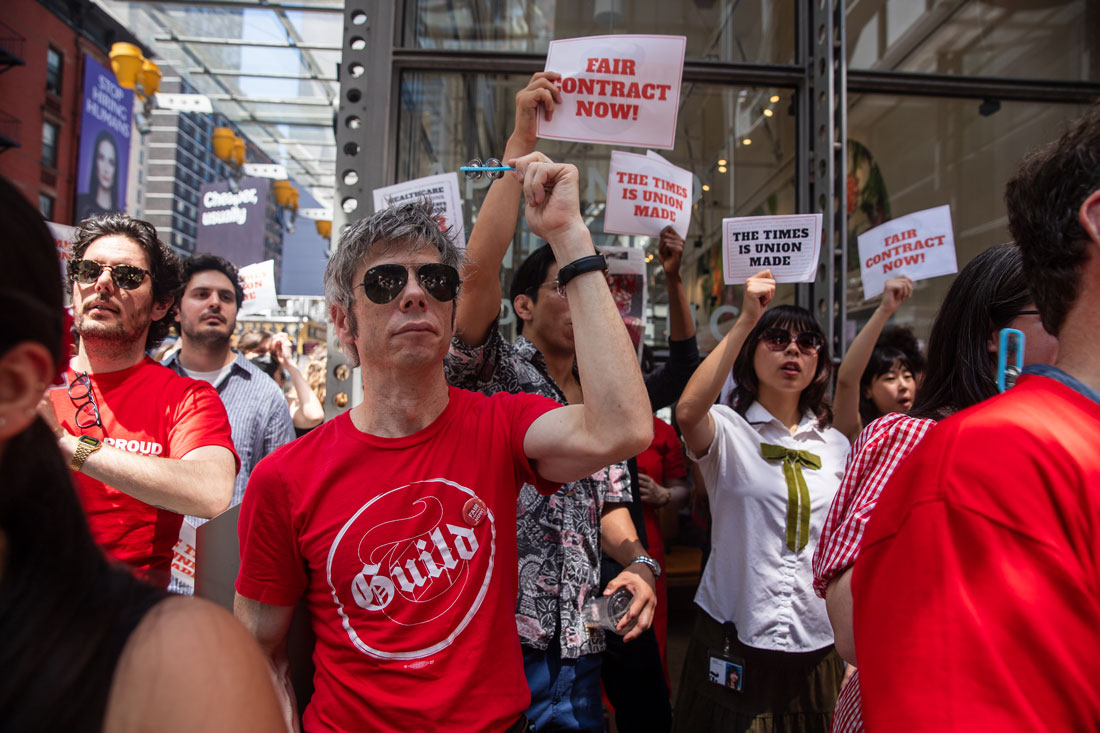
Responding to plans by the New York Times to cut 100 newsroom jobs by the end of the year, the New York Guild reached agreement on a voluntary buyout program that had a Dec. 7 applicant deadline—with those accepting the deal out the door just two days later. Benefits generally included three weeks of pay per year of service, plus some extended medical coverage. Separately, the Times announced it would be subcontracting its News Service work to the company-owned Gainesville Sun, threatening the jobs of an additional 28 Guild-represented staffers in New York.
The Washington-Baltimore Guild welcomed the online staff of WashingtonPost.Newsweek Interactive at a recent party. More than 100 WPNI workers will be able to join the Guild as they’re integrated into the Post’s downtown Washington, D.C. office over the next couple of months after years of being segregated in northern Virginia. The online workers will benefit from shifting from “at will” to “just cause” employment status and will be covered by the Guild’s current contract, which runs through June 2011.
Management at the Akron Beacon Journal finally unveiled its economic proposal—a scorched-earth compendium of 19 different pay and benefit cuts that Guild representatives calculated would amount to a 25%-36% reduction for employees, depending on their seniority and health care coverage, including a 17% slash in wages. In defending the proposal, company negotiators stressed they’re not pleading poverty, they simply “don’t want” to maintain current compensation levels.
The war over Philadelphia Inquirer sports columnist Stephen A. Smith continues, with the Philadelphia Guild filing a grievance charging Inquirer editor Bill Marimow with ignoring an arbitrator’s decision. Smith was officially returned to his old job Nov. 12—some 27 months after the newspaper demoted him—but was told his column would not be published unless he pledged to agree to an Inquirer code of ethics and ended all outside work. Both demands, said the local’s executive director, Bill Ross, violate the Guild contract and are “a clear retaliation for losing the arbitration.”
Caribbean International News Corp. has been ordered by a federal court to restore more than $1.2 million to the El Vocero de Puerto Rico Union Employees Savings and Investment Plan, a retirement plan for the company’s unionized employees. A lawsuit filed by the U.S. Department of Labor simultaneously with the judgment alleges that El Vocero violated the Employee Retirement Income Security Act by failing to deposit into the plan contributions withheld from employees’ wages and to collect matching employer contributions during the period from 2003 to 2006. The suit also alleges that the company owed $1,432,233 to the plan.
The only surviving Guild local in New Jersey may be about to disappear. Members were voting at press time whether Hudson County Newspaper Guild would merge with the New York Guild. Local 31402 represents workers at the Jersey Journal.
This issue of The Guild Reporter went to press December 2.
|